

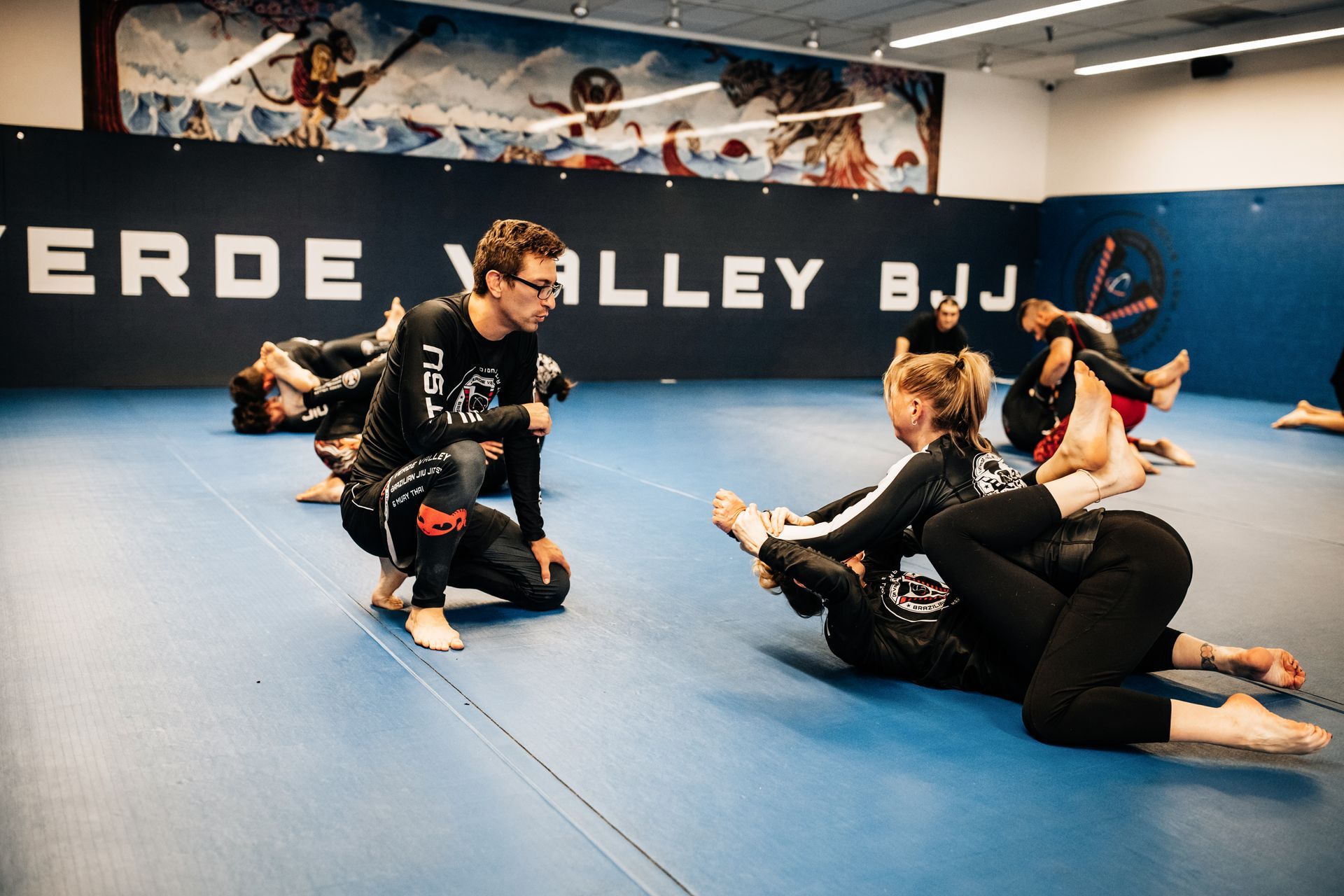
Brazilian Jiu Jitsu gives you a safe way to practice pressure so everyday stress stops calling the shots.
Anxiety rarely shows up at convenient times. It hits in the quiet moments, on the drive to work, while you are scrolling at night, or when you are trying to be present with your family and your mind keeps running ahead. What surprises many new students is that Brazilian Jiu Jitsu can be a practical way to train your nervous system, not just your body.
We see it constantly in adult Brazilian Jiu Jitsu in Cottonwood: you come in for fitness, self defense, or curiosity, and you end up leaving with a steadier baseline. Research backs this up too. In studies of adult practitioners, 87.5 reported reduced anxiety, 96.9 reported improved mood, and 87.6 reported boosted confidence, with 100 reporting a strong sense of community. Those numbers are big, but what matters most is how that change feels in your day to day life.
In Cottonwood, where options can feel limited and life can get isolated fast, training becomes a reliable weekly anchor. You are not just learning positions and submissions. You are practicing how to breathe, think, and respond when things get uncomfortable, and that skill transfers.
Why anxiety responds so well to Brazilian Jiu Jitsu training
Anxiety is not only a thought problem. It is also a body problem. When your nervous system is stuck in high alert, even small challenges can feel personal and overwhelming. Brazilian Jiu Jitsu puts you in controlled stress on purpose, then teaches you to solve it with structure. That is a powerful combination.
The best way to describe it is stress inoculation. You experience pressure in a supervised environment, learn to stay present, and discover that you can recover. Over time, your brain starts treating pressure as information instead of danger. Some recent combat sports research even found Brazilian Jiu Jitsu had one of the strongest correlations with anxiety reduction compared with other disciplines, which fits what we see on the mats.
There is also the neurological side. Training is physical, social, and skill based, which can support mood and resilience through healthier stress responses and pro social bonding. You do not need to know the chemistry names for it to matter, but many people notice that after class, the nervous edge softens and the mind gets quieter.
The mindset skills you build on the mats (without trying to)
A lot of people think mindset training is going to look like motivational speeches. In practice, Brazilian Jiu Jitsu mindset is built through repetition, feedback, and the simple fact that the mat does not let you fake it. That is actually comforting. You do the work, you get better.
Here are a few mental skills we coach indirectly every week:
• Breath control under pressure, because holding your breath makes everything feel harder than it is
• Attention control, because you learn to focus on grips, frames, and position instead of spiraling
• Emotional regulation, because a bad round is data, not a personal failure
• Problem solving, because every position has options if you can slow down enough to see them
• Humility and confidence together, because you can be a beginner and still make progress fast
These skills show up outside the academy in plain ways. You argue less impulsively, you reset faster after a stressful meeting, and you stop assuming discomfort means you are doing something wrong.
What a typical class does to your nervous system
If you are dealing with anxiety, unpredictability can be a trigger. One underrated benefit of training is routine. Our classes follow a structure that is familiar quickly: warm up, technique, drilling, and optional sparring. That rhythm matters because your brain starts trusting the environment.
During technique and drilling, you get the calm, repetitive learning phase. For many adults, this feels almost meditative, especially once you have a few go to movements. Then, if you choose to spar, you enter a more intense phase. You are not being thrown into chaos. You are choosing a controlled challenge with a partner and clear rules.
That choice is important. Anxiety often feels like something happening to you. In training, you practice choosing the hard thing, then recovering from it. Over time, your body learns that activation can be followed by calm, and that pattern is exactly what many anxious adults are missing.
Controlled stress, real confidence, and why rank matters
One of the most interesting findings in the research is that experience correlates with stronger mental health outcomes. Higher ranked practitioners, especially black belts, score significantly higher in resilience, mental strength, self control, self efficacy, life satisfaction, and they report fewer mental health disorders compared with white belts. That does not mean beginners are stuck. It means the longer you practice, the more these traits tend to compound.
We like to frame this as earned confidence. You do not get it from hype. You get it from surviving uncomfortable rounds, learning to protect yourself, and noticing that you can handle more than you thought.
If you are new, the win is not submitting someone. The win is smaller and more meaningful: you show up, you learn one detail, you breathe through a hard position, and you leave better than you arrived.
Why community is a mental health advantage in Cottonwood
In smaller communities, anxiety and stress can be amplified by isolation. If you work from home, commute, or just feel like your circles got smaller after the last few years, it is easy to go days without real connection. Brazilian Jiu Jitsu fixes that in a practical way. You train with people, you solve problems together, and you get regular, face to face accountability.
That social piece is not fluff. In one study, 100 of participants reported a strong sense of community in Brazilian Jiu Jitsu. We believe that matters as much as the physical training, especially for adults who need a place that feels consistent and welcoming while still being challenging.
You end up learning names, not just techniques. You notice familiar training partners. You get the subtle benefit of being seen and included, which can soften anxiety all on its own.
Beginner friendly does not mean easy, it means supported
A common worry is, what if anxiety makes me freeze or panic during sparring. We take that seriously. Beginner friendly training is not about making everything gentle. It is about giving you the right pace, the right partners, and the right expectations so you can build tolerance gradually.
If you are brand new to Brazilian Jiu Jitsu in Cottonwood, we help you start with fundamentals: posture, base, frames, and escapes. Those skills are calming because they give you a plan. When your brain has a plan, it stops catastrophizing.
We also encourage a simple approach early on: drill more, spar later, and keep rounds short. You are still training the nervous system, but you are doing it in a way that builds trust in your body.
A practical weekly plan for anxiety reduction
Consistency beats intensity for mindset. You do not need to train every day for Brazilian Jiu Jitsu to help with anxiety. You need a schedule you can repeat when life gets busy.
A realistic starting plan looks like this:
1. Train 2 to 3 times per week to build momentum without burnout
2. Prioritize fundamentals and positional sparring over trying to win full rounds
3. Track one simple metric, like how quickly you can return to calm breathing
4. Add a short cooldown habit after class, like a five minute walk or light stretch
5. Re assess after 8 to 12 weeks, because that is often when mental benefits become obvious
Longitudinal research on combat sports and mental health frequently points to sustained benefits with continued practice, and we see the same pattern locally. The biggest changes show up when training becomes part of your identity, not a temporary fix.
Sharpening mindset: focus, decision making, and mental flexibility
Anxiety narrows attention. It pulls you into worst case thinking and makes you rigid. Brazilian Jiu Jitsu does the opposite. It forces you to notice options. If your first idea fails, you transition. If you lose position, you rebuild frames. If you feel stuck, you breathe and create space.
That is mental flexibility in real time. And because it is physical, your brain learns it differently than it would from reading or talking about it.
Decision making improves too. You get used to quick, simple choices: hip escape or frame, underhook or guard retention, slow pressure or stand up. Over time, you stop overthinking everything outside the gym because you have practiced acting under pressure thousands of times.
What if you are in your 30s, 40s, or beyond
A lot of adults assume they missed the window to start. We disagree. Adult Brazilian Jiu Jitsu in Cottonwood is full of people balancing work, family, old injuries, and real responsibilities. In many ways, adults benefit even more because the goal is not to win tournaments. The goal is to feel better in your own skin and show up more effectively in your life.
You can train smart. You can choose partners who match your pace. You can explore no gi or gi depending on comfort. You can take breaks when needed. And you still get the psychological gains: improved mood, more confidence, better stress tolerance, and a clearer head.
Common questions we hear about anxiety and training
Does Brazilian Jiu Jitsu really help with anxiety
Yes. Multiple studies report significant reductions in anxiety among practitioners, and many adults describe Brazilian Jiu Jitsu as the most reliable stress management tool they have tried because it trains mind and body together.
How quickly can you notice mental benefits
Some people feel calmer after the first class, simply from movement and social connection. More durable changes usually show up after several weeks of consistent training, and research commonly highlights meaningful improvements within about 8 to 12 weeks.
Can you train if you have panic symptoms or high stress
In many cases, yes, with the right pacing and communication. We can help you start with drilling, positional work, and controlled rounds so your nervous system adapts gradually.
Is sparring required
No. Sparring is a valuable tool, but it is not the only way to learn. We can guide you toward an approach that matches your goals and your current comfort level.
Take the Next Step
If you want anxiety relief that feels tangible, Brazilian Jiu Jitsu is one of the few practices where you can measure progress week to week, not just hope for it. The mat teaches calm problem solving, emotional control, and real confidence because you practice those traits under pressure, then carry them back into regular life.
At Verde Valley Brazilian Jiu Jitsu and Muay Thai, we built our adult program around safe structure, progressive coaching, and a community that shows up for each other in Cottonwood. If you are ready to sharpen your mindset and feel more in control of your stress responses, we would like to help you get started.
Ready to train? Join a Brazilian Jiu-Jitsu class at Verde Valley Brazilian Jiu Jitsu and Muay Thai today.